



Understanding Hazmat Packaging Groups: Degrees of Danger and Safe Handling
Shipping and handling hazardous materials demand precision, responsibility, and strict adherence to federal safety standards. At the heart of this process are hazmat packaging groups—a system designed to classify materials by the severity of the danger they pose during transport.
This blog unpacks what each packaging group means, how they are assigned, examples by hazard class, the governing regulations, and what safety professionals need to know to stay compliant and protect workers.
What Are Hazmat Packaging Groups?
Hazardous materials are grouped into three Packing Groups (PGs) defined by the U.S. Department of Transportation (DOT) and outlined in 49 CFR Part 173, Subpart D:
- Packing Group I: High danger — requires the most robust, durable packaging.
- Packing Group II: Medium danger — requires strong, tested packaging with standard safeguards.
- Packing Group III: Low danger — minimal hazard; standard packaging generally sufficient.
These categories ensure that every hazardous material is contained and shipped with protection proportional to its risk. For example, a corrosive acid that burns skin on contact would be PG I, while a mild cleaning solvent might be PG III.
The Purpose of Hazmat Packaging Groups
The primary goal of packaging groups is safety and standardization. They:
- Prevent leaks, spills, and chemical reactions during transport.
- Protect workers, transporters, and the public.
- Ensure consistent labeling and documentation under federal law.
- Facilitate emergency response in case of an accident.
By aligning the packaging method with the material’s hazard level, regulatory agencies and employers minimize environmental and health risks.
How Packaging Groups Are Assigned
Determining a material’s packing group isn’t guesswork—it’s a science-driven process. Each material is tested for flammability, toxicity, reactivity, or corrosiveness. Results are compared against threshold criteria listed in 49 CFR 172.101 (Hazardous Materials Table).
Tests include:
- Flash point and boiling point for flammable liquids.
- Burning rate for solids and oxidizers.
- LD50 (lethal dose) and LC50 (lethal concentration) for toxic substances.
- Skin corrosion and pH for corrosive materials.
After evaluation, the material is assigned both a hazard class and packing group, which dictate the proper packaging, labeling, and shipping documentation.
Hazard Classes and Examples by Packaging Group
Hazardous materials fall into nine classes. Each can contain substances of varying severity that determine the assigned packaging group.
Class 3: Flammable Liquids
Definition: Liquids with a flash point of 140°F (60°C) or below.
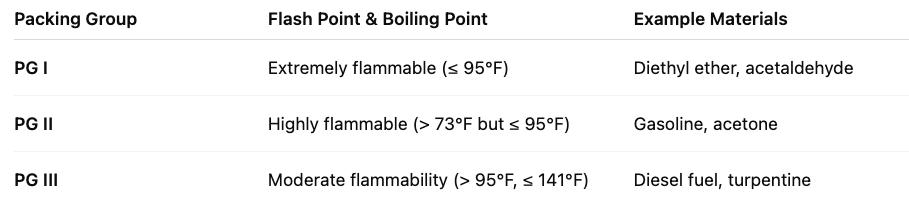
Safety Note: Workers should use flame-resistant clothing (NFPA 2112-rated), chemical-resistant gloves, and ensure all storage is grounded to prevent static ignition.
Class 4: Flammable Solids, Spontaneously Combustible, and Dangerous When Wet
Division 4.1 – Flammable Solids
Burn readily under transport conditions.
- PG II: Readily combustible powders (e.g., magnesium powder).
- PG III: Less reactive solids (e.g., camphor, sulfur).
Division 4.2 – Spontaneously Combustible Substances
Ignite when exposed to air.
- PG I: Pyrophoric metals like phosphorus.
- PG II: Self-heating materials (e.g., coal).
- PG III: Materials that self-heat slowly (e.g., seed cake).
Division 4.3 – Dangerous When Wet
React violently with water.
- PG I: Sodium, lithium.
- PG II: Calcium, potassium.
- PG III: Aluminum powder.
Safety Tip: Handle with non-sparking tools, wear flame-retardant clothing, and avoid moisture exposure.
Class 5: Oxidizers and Organic Peroxides
These materials supply oxygen and intensify combustion.
Division 5.1 – Oxidizers
- PG I: Very strong oxidizers (e.g., potassium chlorate).
- PG II: Moderate oxidizers (e.g., calcium hypochlorite).
- PG III: Weak oxidizers (e.g., hydrogen peroxide solutions < 8%).
Division 5.2 – Organic Peroxides
- Common in resins, plastics, and accelerants. Many are temperature-sensitive and explosive under heat.
Safety Tip: Store separately from flammables; use insulated, ventilated storage and flame-resistant PPE.
Class 6: Toxic and Infectious Substances
Division 6.1 – Toxic Substances
Based on LD50 and LC50 test results.
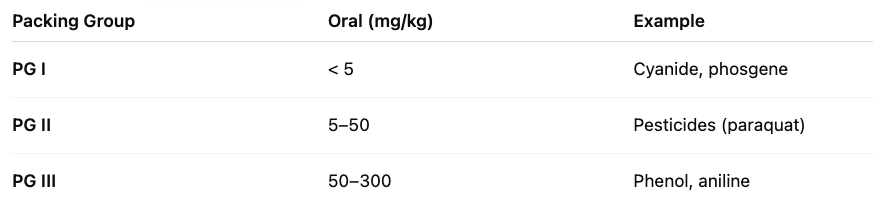
Division 6.2 – Infectious Substances
Includes medical samples or pathogens (e.g., Ebola, COVID-19 specimens).
Safety Tip: Workers must wear impermeable gloves, face shields, and respirators (NIOSH-approved). OSHA’s Bloodborne Pathogens Standard (29 CFR 1910.1030) applies.
Class 8: Corrosive Substances
These materials cause irreversible damage to skin, metal, or other materials.
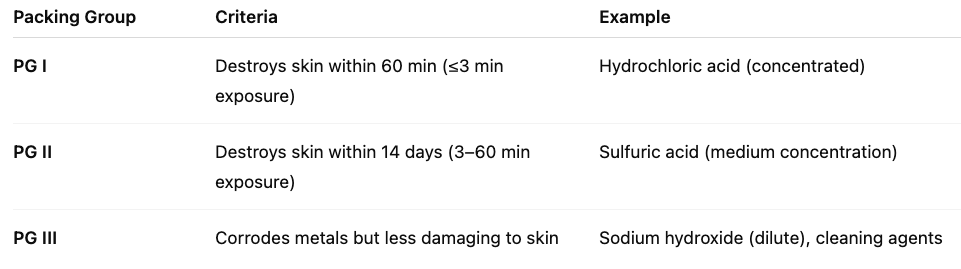
Safety Tip: Use acid-resistant gloves, full face shields, and aprons. Ensure eyewash stations are within 10 seconds of work zones.
Class 9: Miscellaneous Dangerous Substances
These include environmentally hazardous materials and other risks not covered by previous classes—like dry ice, lithium batteries, and asbestos. Packaging groups vary and are often specified in the Hazardous Materials Table (49 CFR 172.101).
Regulatory Oversight and Standards
DOT & PHMSA (49 CFR Parts 171–180): The U.S. Department of Transportation and its agency, PHMSA (Pipeline and Hazardous Materials Safety Administration), regulate packaging groups, labeling, and shipping documentation.
OSHA (Occupational Safety and Health Administration): OSHA enforces workplace exposure controls under the Hazard Communication Standard (29 CFR 1910.1200) and Hazardous Waste Operations and Emergency Response (HAZWOPER, 29 CFR 1910.120).
EPA: The Environmental Protection Agency regulates hazardous waste handling under RCRA and related generator improvement rules. Together, these agencies ensure that materials are safely handled, packed, labeled, and transported across the supply chain.
Industries That Must Follow Hazmat Packaging Rules
Packaging group compliance is essential in any industry handling chemicals, fuels, or regulated waste, including:
- Manufacturing (paints, solvents, adhesives)
- Construction (flammable sealants, coatings)
- Transportation & logistics (freight, shipping carriers)
- Healthcare (infectious waste, pharmaceuticals)
- Oil & Gas (fuels, corrosives)
- Laboratories & R&D (reactive chemicals, specimens)
Failure to comply can lead to civil penalties exceeding $100,000 per violation, shipment rejection, and increased liability in workplace incidents.
PPE and Safety Measures for Handling and Packaging Hazmat
Even the best packaging can’t replace safe handling. Safety managers should ensure:
- Chemical-resistant gloves and eye protection are worn for all liquid chemicals.
- Respirators (NIOSH-approved) for inhalation hazards.
- Flame-resistant clothing (FR) for flammable substances.
- Anti-static footwear to prevent ignition.
- Spill kits and secondary containment are on-site.
Personnel should also be trained under 49 CFR 172.704 for hazmat awareness and function-specific duties.
Frequently Asked Questions (FAQs)
- What determines a material’s packaging group?
Packing groups are assigned based on the degree of danger determined through laboratory testing and DOT hazard classification. - Can one hazard class include multiple packing groups?
For instance, Class 3 (flammable liquids) can be PG I, II, or III depending on the substance’s flash point and volatility. - Who is responsible for assigning the packing group?
The shipper or manufacturer must classify the material, using test data and DOT criteria. - What happens if a shipment is misclassified?
Incorrect classification can result in fines, rejected shipments, and safety incidents due to improper packaging or labeling. - Are there international equivalents?
The United Nations Recommendations on the Transport of Dangerous Goods mirror U.S. standards to support global consistency. - Is PPE required when packaging hazmat?
Even when materials are sealed, packaging and labeling processes often involve handling dangerous substances. - How often must packaging be retested or re-certified?
UN/DOT-approved packaging must undergo periodic testing (typically every 12–24 months) to verify performance standards.
Conclusion: Safety Starts with Classification
Hazmat packaging groups are more than bureaucratic codes—they are the backbone of safe transport. By correctly classifying, labeling, and packaging materials according to DOT and OSHA standards, companies protect not just their compliance record but also the workers on the front lines of industrial logistics.
Safety managers play a vital role in ensuring each shipment—no matter how routine—meets the right standards, with proper PPE, documentation, and emergency preparedness in place.
Sources
- “Hazmat Packing Groups: Understanding Degrees of Danger.” Maine LabPack, mainelabpack.com/blog/hazmat-packing-group-degrees-danger/.
- “49 CFR Subpart D — Definitions, Classification, Packing Group Assignments and Exceptions for Hazardous Materials Other Than Class 1 and Class 7.” eCFR: Electronic Code of Federal Regulations, U.S. Government Publishing Office, ecfr.gov/current/title-49/subtitle-B/chapter-I/subchapter-C/part-173/subpart-D.
- “Hazard Communication: Hazard Classification Guidance for Manufacturers, Importers, and Employers (OSHA Publication 3844).” Occupational Safety and Health Administration, U.S. Department of Labor, https://www.osha.gov/sites/default/files/publications/OSHA3844.pdf.