


Wildfire activity across the United States is expected to intensify in 2026, driven by worsening drought conditions, persistent heat, and dry vegetation. For safety professionals, emergency responders, and workers in high-risk environments, this forecast highlights an urgent need to reassess protective strategies—especially when it comes to wildfire PPE and protective clothing.
Understanding the scale of the threat and preparing with the right safety gear can help reduce injuries, improve response effectiveness, and protect workers exposed to fire, smoke, and airborne contaminants.
Wildfire Risk in 2026: A Growing Threat
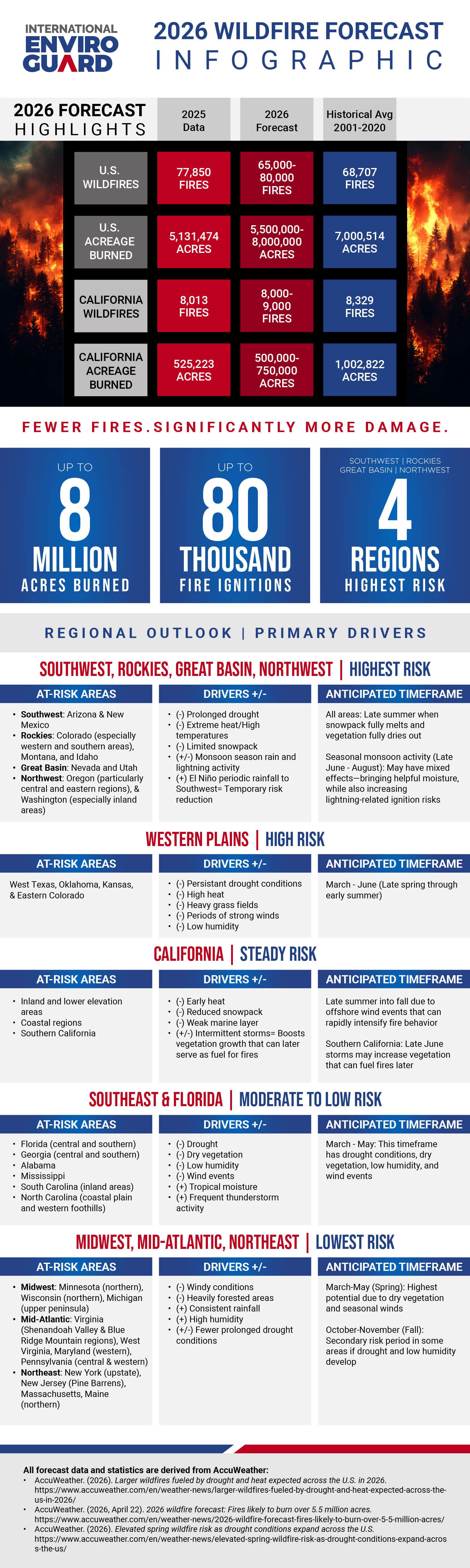
According to AccuWeather’s 2026 U.S. wildfire forecast, the U.S. could experience 65,000 to 80,000 wildfires in 2026, with 5.5 million to 8 million acres burned nationwide.
This places wildfire activity above recent years and near or above long-term historical averages.
For comparison:
- 2025 saw approximately 77,850 fires and over 5.1 million acres burned
- The historical average is roughly 68,700 fires and 7 million acres burned annually
- In California, 500,000-750,000 acres of land are expected to burn in 2026, compared to 525,223 acres in 2025.
In addition to U.S. wildfire activity, Canada is expected to see 11 to 15 million acres burned, significantly above its historical average of 5.7 million acres.
These numbers reflect a broader trend: wildfires are becoming larger, more intense, and more difficult to control. According to AccuWeather’s Long-Range Expert, Paul Pastelok, “Even if the total number of fires across the country is lower than last year, that does not mean the overall risk is reduced. We expect hundreds of thousands, if not millions, more acres to burn this year.”
In addition to regions or states that are most impacted by wildfires (California, Texas, Alaska, Arizona, etc.), the risk of wildfires is spreading beyond these traditional areas. In 2024, wildfires were reported in all 50 states.
Wildfires are no longer a regional concern; they are becoming a national concern.
Why Wildfires Are Expected to Be Larger in 2026
Several environmental factors are converging to create high-risk conditions:
- Widespread Drought
Drought is one of the most significant drivers of wildfire activity. In early 2026, drought conditions covered more than 40% of the United States, with some regions experiencing severe moisture deficits.
Dry soil, dry vegetation, heat, and wind are a dangerous combination that allow fires to ignite easily, spread rapidly, grow larger, and ultimately make them harder to contain.
- Increasing Heat
Rising temperatures dry out vegetation faster and extend fire seasons. Warmer conditions also increase evaporation rates, further intensifying drought.
- Wind and Dry Vegetation
Wind and dry vegetation are large contributors to the spread of wildfires. Dry vegetation acts as fuel that keeps fires burning, while wind blows sparks and flames that enable fire to spread farther and quicker.
- Earlier Start to Fire Season
In many regions, wildfire season is starting earlier in the year due to dry spring conditions. This increases the duration of exposure risk for workers and responders.
- Lower Than Average Snowpack
Snow levels across much of the interior Northwest were significantly below the historical average this winter. An intense, record-breaking heat wave in the Southwest during March caused the snow to melt much earlier than usual. As a result, the reduced moisture from rapid snowmelt and spring runoff is causing grasses and other vegetation to dry out more quickly this year.
High-Risk Regions in the U.S.
While wildfire risk exists nationwide, several regions are expected to face elevated threats:
- Western U.S. (California, Southwest, Rockies)
- Southern Plains and High Plains
- Southeast (early-season wildfire activity)
- Interior Mid-Atlantic and Appalachian regions
These areas may experience rapid fire growth due to dry fuels, high temperatures, and variable wind conditions.
Regional Wildfire Risk Outlook
California
Wildfire potential is expected to build steadily through the summer, particularly across inland and lower-elevation areas where early heat and reduced snowpack will speed up vegetation drying. Coastal regions could see fire conditions develop sooner than usual due to a weaker marine layer.
In Southern California, intermittent storms beginning in late June may temporarily reduce fire danger, but any resulting vegetation growth could later serve as additional fuel. The most critical period is anticipated from late summer into fall, especially during offshore wind events that can rapidly intensify fire behavior.
Southwest, Rockies, Great Basin, and Northwest
This region is likely to be the most vulnerable overall due to persistent drought, elevated temperatures, and limited snowpack. Seasonal monsoon activity may have mixed effects—bringing helpful moisture in some cases, while also increasing lightning-related ignition risk.
In the Northwest, wildfire conditions are expected to worsen later in the summer as snowpack fully melts and fuels dry out. Additionally, increased tropical activity in the eastern Pacific, along with a developing El Niño pattern, could introduce periodic rainfall to parts of the Southwest, offering some potential for temporary risk reduction.
Plains
The greatest wildfire threat is concentrated in the western Plains, including western Texas, Oklahoma, Kansas, and eastern Colorado. Fire activity in these areas will likely be driven by periods of strong winds and low humidity. In contrast, the eastern Plains should experience lower risk overall due to more consistent moisture and storm activity.
Southeast and Florida
Fire danger may be elevated early in the season in areas still affected by drought. However, conditions are expected to improve as the season progresses, with increasing thunderstorm activity and tropical moisture helping to reduce fire potential.
Midwest, Mid-Atlantic, and Northeast
Wildfire risk across these regions is generally expected to remain low due to frequent rainfall and higher humidity levels. Some localized fire potential exists in areas such as the Shenandoah Valley and Blue Ridge Mountains, but any incidents are likely to be short-lived and associated with brief periods of dry, windy weather.
Why This Matters for Worker Safety
Wildfires present numerous hazards—not just flames. Workers in fire zones, industrial sites, utilities, transportation, and construction may face:
- Direct fire and radiant heat exposure
- Smoke inhalation
- Fine particulate matter (PM2.5, PM10)
- Toxic gases: carbon monoxide, PAHs, volatile organic compounds
- PFAs from firefighting foams
- Metals: from soil, minerals in vegetation, and human-made sources (wiring, electronics, paints, and roofing materials)
- Diesel exhaust
- Asbestos and building-material combustion products
- Aldehydes/formaldehyde from burning vegetation and burning structures (plastics, insulation, fabrics, resins)
- Benzene from burning vegetation and human-made materials like plastics/PVC, adhesives, sealants, and more
- Reduced visibility
- Heat stress and dehydration
Even workers not directly fighting fires can be exposed to hazardous air quality. Smoke can travel hundreds of miles, affecting job sites and communities that are far from the fire itself.
The Importance of Wildfire PPE and Protective Clothing
With wildfire risks increasing, safety professionals must ensure workers are equipped with appropriate PPE. The goal is to protect against both thermal hazards and airborne contaminants.
- Primary Flame-Resistant (FR) Clothing | Primary FR
Primary flame-resistant garments are essential for workers exposed to ignition risks, radiant heat, or fire proximity.
Key benefits:
- Self-extinguishing properties
- Reduced burn injury severity
- Protection against flash fire conditions
- Secondary FR Protective Coveralls and Outerwear
Secondary FR protective garments are designed to be worn over top of primary FR garments—they should never be worn alone or as the sole FR garment. Not only do secondary FR garments protect underlying primary FR garments, but they can also help protect against:
- Ash and soot contamination
- Chemical exposure
- Particulate exposure
- Dirt, grease, and other grime
- Surface contamination
In some environments, low-linting and/or clean-processed garments may be needed to reduce cross-contamination.
- Respiratory Protection
Smoke exposure is one of the most significant wildfire hazards.
Workers may require:
- N95 or P100 respirators for particulate filtration
- Half-mask or full-face respirators for extended exposure
- Supplied-air systems (SCBA) in high-risk environments
Wildfire smoke contains fine particulate matter (PM2.5), which can penetrate deep into the lungs and contribute to respiratory and cardiovascular issues. Prolonged exposure is linked to more serious respiratory conditions such as Chronic Obstructive Pulmonary Disease (COPD), mesothelioma, bladder cancer, and lung cancer among others.
- Eye and Face Protection
Smoke, ash, and debris can irritate or damage the eyes.
Recommended PPE:
- Safety goggles or sealed eyewear
- Face shields in high-debris environments
- Heat Stress Protection
Wildfire conditions often involve extreme temperatures.
Additional protective measures include:
- Cooling gear
- Hydration strategies
- Rest breaks and/or implementing shifts
- Implementing acclimatization protocols
- Lightweight, breathable PPE
Smoke Exposure: A Hidden Hazard
Wildfire smoke can affect workers far beyond the fire zone. Fine particulate matter (PM2.5) and toxic gases can lead to:
- Short-term respiratory irritation
- Reduced lung function
- Increased risk of cardiovascular events
- Long-term health effects with repeated exposure
This makes respiratory PPE and air quality monitoring essential, even for workers not directly involved in firefighting.
Best Practices for Safety Professionals
To prepare for the 2026 wildfire season, organizations should:
Conduct Risk Assessments
Evaluate:
- Possible duration of exposure
- Geographic risk exposure (smoke drift to other areas)
- Job tasks and outdoor work conditions
- Historical wildfire patterns
Update PPE Programs
Ensure workers have access to:
- Flame-resistant clothing—both primary and secondary FR
- Respiratory protection
- Eye and face protection
- Protective outerwear (gloves, boots, etc.)
Train Workers
Workers should understand:
- Smoke hazards
- Proper PPE usage and limitations, including donning and doffing procedures
- Emergency procedures
Monitor Air Quality
Use real-time data to determine when additional protections are required.
Plan for Extended Exposure
With longer fire seasons, PPE programs must account for sustained use, replacement, repairs, and proper decontamination and/or laundering if applicable. Longer wildfire “seasons” mean workers will experience prolonged exposure to hazards. Prolonged exposure to fires (wildland, structural, vehicular) is directly linked to serious health conditions like cancers, COPD, and mesothelioma.
The Bottom Line
The 2026 wildfire outlook signals a challenging year ahead. With up to 80,000 wildfires expected and millions of acres at risk, safety professionals must take proactive steps to protect workers.
Although the forecast predicts fewer fires, these fires are expected to be much larger, harder to control, and to burn more acreage. Drought, heat, and dry vegetation are creating conditions for larger, more intense fires—and increased exposure risks for workers across multiple industries.
The right combination of wildfire PPE, flame-resistant clothing, and respiratory protection is essential for reducing injuries and maintaining safe operations.
Preparation today can make the difference when wildfire conditions escalate tomorrow.
Sources and References
- Butler, C., Hale, C., Navarro, K., Dalsey, E., Kardous, C. A., Graydon, P. S., & Byrne, D. C. (2020, September 28). Wildland firefighter health: Some burning questions. Centers for Disease Control and Prevention, National Institute for Occupational Safety and Health (NIOSH).
https://www.cdc.gov/niosh/bulletin/2020/wildland-firefighter-health.html - Liu, J. C., et al. (2018). A systematic review of the physical health impacts from non-occupational exposure to wildfire smoke. Environmental Research.
https://pmc.ncbi.nlm.nih.gov/articles/PMC6101969/ - Reid, C. E., et al. (2021). Critical review of health impacts of wildfire smoke exposure. Environmental Health Perspectives.
https://pmc.ncbi.nlm.nih.gov/articles/PMC8456726/ - Zhang, Y., et al. (2024). Wildfire smoke composition and toxicity (Article No. 4c06653). Environmental Science & Technology. American Chemical Society.
https://pubs.acs.org/doi/10.1021/acs.est.4c06653 - Zhang, M., et al. (2026). Wildfire smoke PM2.5 and mortality in the contiguous United States.
https://pmc.ncbi.nlm.nih.gov/articles/PMC12488353/ - AccuWeather. (2026). Larger wildfires fueled by drought and heat expected across the U.S. in 2026.
https://www.accuweather.com/en/weather-news/larger-wildfires-fueled-by-drought-and-heat-expected-across-the-us-in-2026/ - AccuWeather. (2026, April 22). 2026 wildfire forecast: Fires likely to burn over 5.5 million acres.
https://www.accuweather.com/en/weather-news/2026-wildfire-forecast-fires-likely-to-burn-over-5-5-million-acres/ - AccuWeather. (2026). Elevated spring wildfire risk as drought conditions expand across the U.S.
https://www.accuweather.com/en/weather-news/elevated-spring-wildfire-risk-as-drought-conditions-expand-across-the-us/ - Hoosier Ag Today. (2026). AccuWeather predicts active 2026 wildfire season amid drought concerns.
https://hoosieragtoday.com/news/accuweather-predicts-active-2026-wildfire-season-amid-drought-concerns/